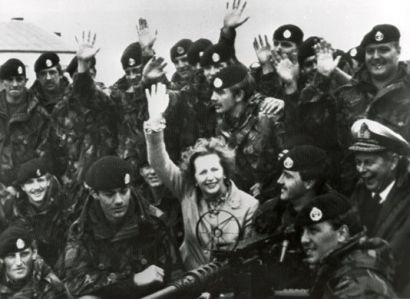
Former
Prime Minister Margaret Thatcher with British troops
on their
way to defend British sovereignty over the Falkland
Islands, known
in Latin America as the Malvinas, in 1983.
Opera Mundi, Brazil
Latin America Must
End British Colonialism and U.S. Imperialism
"The
tragedy of the Latin American countries, with their aberrant background of
exploitation, misery and de-culturation, has one and only one set of enemies:
European neo-colonialism and U.S. imperialism. … there is a way out of the
impasse over the Falkland Islands - one that is majestic, British and sensible,
and something that would be much appreciated in the south of our continent."
The European Union’s decision
to recognize the Malvinas
Islands as its territory, endorsing the warlike positions of British Prime
Minister David Cameron - who approved a plan to increase the military
contingents on the islands - serves to rekindle a historical fact that must
never be forgotten: the tragedy of the Latin American countries, with their
aberrant background of exploitation, misery and de-culturation, has one and only
one set of enemies - European neo-colonialism and U.S. imperialism.
[Editor's Note: The Falkland
Islands, a British protectorate, are called the Malvinas Islands by Argentines,
who regard them as Argentine territory].
But there has been a political
update from the currency board - a system invented by the English Empire to
control its domains: If a colony has no autonomy, and the economy fluctuates
based on the mercy of the trade deficit, and that in terms of geopolitics appears
threatening, the peripheral countries resume their orbit around the dictates of
the great powers. Cameron takes off his silk ties and suits in order, three
decades later, to reaffirm Margaret Thatcher’s rhetoric.
From the deck of the
destroyer HMSAntrim, hit by an unexploded bomb,
Thatcher gave the last speech on her five-day tour of the Malvinas [Falkland
Islands]: “One thing is clear: these islands are British, its inhabitants are subjects
of Queen Elizabeth II, and they want to remain as such.” Directing herself to
the journalists that accompanied her, she reiterated that, “you cannot
negotiate sovereignty with the Argentines. We extended our hand to Argentina.
They didn’t respond. We trust that they will one day. But we will not negotiate
on our sovereign position.”
Cameron must ignore that
history has its reasons, which must be taken into account. The adventure that
was Leopoldo
Galtieri’s military regime [1981-82] intended to remain in government indefinitely
- or as long as possible. In 2012, Cristina Kirchner represents a political
model that has been underway in the region for some time - one that is more
democratic, humane and that emphasizes the structural reforms necessary after
the disassembly promoted by neoliberalism.
Contrary to the “reel,” a typical English dance, the tango is danced in
silence; it doesn’t count on words but on movements and gestures.
The self-determination of the
Kelpers [Falkland Islanders],
the central argument used by Thatcher and Cameron, encompasses a contradiction
that is difficult to overcome. How can they claim British citizenship and the
right to self-determination? What we have, in fact, is a permanent colonial
occupation dressed up as “independence.” There is no more objective condition
for the oppressed to recall a memory that was manufactured by the oppressor.
Remember that if 30 years ago,
the countries of Latin American went far beyond the predictable in their
support of Argentine rights, not giving one meter of territory for British military
aircraft to refuel, now the resistance would be much more intense, with the
region structured into communities like UNASUR
[Union of South American Nations] and CELAC
[Community of Latin American and Caribbean States]. A military venture would
impose political costs much more profound than its creators can imagine.
There is nothing impeding the
launch of bilateral discussions on the Malvinas. There is an important
precedent for this: the document
signed with Argentina in 1968 by Harold Wilson’s Labour government, which
came into force only after being delayed by the election victory of Edward
Health's conservatives in the 1970 elections.
Article 4 of the 'Memorandum
of Understanding' is very clear. “The government of the United Kingdom will recognize
Argentine sovereignty over the islands with effect from a date to be agreed.
This date will be fixed as soon as the government of Her Britannic Majesty is
satisfied with the guarantees and safeguards offered by the Argentine
government to defend the interests of its inhabitants.”
As you can see, there is a
way out of the impasse - one that is majestic, British and sensible and something
that would be much appreciated in the south of our continent.
*Gilson Caroni Filho is a
professor of Sociology at the Faculdades Integradas Hélio Alonso (Facha) in Rio
de Janeiro, a columnist for Carta Maior and a collaborator with Jornal do
Brasil. This article was originally published in Carta Maior.